


Remote data science jobs give professionals the opportunity to solve analytical problems for companies without working from a traditional office every day. These positions can involve product analytics machine learning fraud detection pricing customer behavior experimentation forecasting artificial intelligence and business strategy. The strongest candidates are not only able to write Python code or train a model. They can understand a business problem find reliable data test assumptions and explain limitations before turning technical results into useful recommendations. This guide covers the main types of remote data science roles in the United States. It also explains career levels required skills portfolio expectations salary factors application methods and the remote interview process.
Readers who are still comparing different technology careers can first review our broader remote IT jobs guide. Candidates who prefer building software systems and production applications can also explore our guide to remote software engineering roles.
What Are Remote Data Science Jobs?
A remote data scientist uses programming statistics and analytical methods to find useful patterns in data and help organizations make better decisions. The work may involve collecting information cleaning datasets defining metrics running experiments developing predictive models and presenting findings to decision makers. The official O*NET Data Scientists profile describes the occupation as turning raw data into meaningful information through programming, visualization data mining modeling natural language processing and machine learning. Remote work changes where these responsibilities are completed but it does not remove the need for teamwork. A data scientist may still collaborate with product managers engineers analysts and business leaders throughout a project.
Fully Remote Hybrid and Remote Eligible Roles
A fully remote role normally allows an employee to complete regular work outside the company office. The person may still need to attend scheduled meetings and remain available during agreed working hours. A hybrid role combines remote work with office attendance. The employer may require employees to visit an office on certain days or attend occasional in person meetings. A remote eligible role may allow home based work after onboarding or manager approval. Some positions are remote within the United States but still exclude certain states. Applicants should read the complete location and work arrangement before applying. The word remote does not automatically mean that a role is available from every city or country.
Why Remote Data Science Roles Have Location Restrictions
A company may only be registered to employ workers in certain states. It may also need employees to work within particular time zones so data teams can collaborate with product teams and decision makers during shared hours. Some data science roles involve financial healthcare or customer information. These positions may have additional security requirements and stricter rules about where the work can be completed. A company may also require occasional travel for team meetings or customer projects. Before applying check the approved location working hours travel expectations and work authorization requirements.
Data Scientist Versus Data Analyst
A data analyst often concentrates on reports, dashboards trends and recurring business questions. The work may focus on explaining what has already happened and helping teams monitor performance. A data scientist may work more deeply with experimentation statistical modeling forecasting and predictive methods. The scientist may investigate why something happened and estimate what could happen next. The boundary is not the same at every company. Some data analyst roles include advanced modeling while some data scientist positions focus mainly on SQL and reporting. Applicants should evaluate the responsibilities instead of relying only on the job title.
Data Scientist Versus Machine Learning Engineer
A data scientist usually spends more time exploring information testing hypotheses developing models and communicating findings. A machine learning engineer often focuses more heavily on production systems. This may include model deployment infrastructure monitoring and application performance. Many employers combine both areas. A data scientist may be expected to operationalize models while an engineer may contribute to model evaluation and feature development. Read the job description carefully to understand how much analysis and production engineering the role requires.
What Types of Remote Data Science Jobs Are Available?

Remote data science is not one fixed career path. The work changes according to the product industry dataset and business decision being supported. Some positions focus on experiments and product growth while others investigate fraud forecast demand improve pricing or develop machine learning systems. Understanding these differences can help applicants focus on roles that match their current skills and experience.
Product Data Scientist
A product data scientist studies how people use a digital product. The work may include analyzing user behavior building metrics defining measurement frameworks and evaluating new features. The scientist often works with product managers designers and engineers. A product team may want to know whether a new feature improved retention or whether a recent change created an unexpected problem. Strong candidates understand experimentation and can translate technical findings into product strategy. They should also know when the available evidence is not strong enough to support a confident decision.
Machine Learning Data Scientist
A machine learning data scientist develops models that classify information or predict future outcomes. The work may involve regression classification clustering recommendation systems forecasting or anomaly detection. The role requires more than selecting an algorithm. The scientist must prepare the dataset choose an appropriate evaluation method and understand the impact of incorrect predictions. Some employers expect the scientist to deploy the model while other companies have machine learning engineers who handle production systems. Applicants should check whether the position focuses mainly on research analysis or applied production work.
Marketing and Customer Analytics Data Scientist
A marketing data scientist examines customer acquisition retention campaign performance and purchasing behavior. The scientist may identify customer segments or measure which marketing activities contribute to growth. This work often combines SQL statistics visualization and experimentation. The final result should help the company make a practical decision rather than simply produce another report. Candidates should understand attribution limits selection bias and the difference between correlation and causation.
Fraud and Risk Data Scientist
A fraud data scientist investigates unusual behavior and develops methods for identifying risk. The work may include analyzing transactions, account activity device signals or payment patterns. A strong fraud model must identify suspicious activity without blocking too many legitimate users. This creates an important balance between risk prevention and customer experience. Senior specialists may lead end to end data science work define fraud metrics and collaborate with engineering operations compliance and security teams.
Pricing and Revenue Data Scientist
A pricing data scientist studies how changes in price affect demand revenue and customer decisions. The work may include forecasting experimentation customer segmentation and profitability analysis. Pricing decisions can affect several parts of a business at the same time. A change that improves short term revenue may reduce retention later. The scientist must understand these tradeoffs and explain the assumptions behind each recommendation. Strong quantitative analysis is important but understanding customer behavior is equally valuable.
Decision Scientist
A decision scientist helps teams compare possible actions. The role may combine statistics, experimentation operations research and business strategy. Instead of focusing only on model accuracy the scientist considers which decision the organization needs to make. The final result may be a recommendation measurement framework or scenario analysis. Decision scientists often work with leaders who need clear answers. This makes communication and stakeholder management important parts of the role.
Research Data Scientist
A research data scientist investigates advanced analytical methods. The work may involve natural language processing computer vision deep learning or specialized scientific research. Some research positions require a master’s degree or doctorate while others accept strong professional experience and a record of applied projects. Candidates may need to read academic papers reproduce methods and design reliable evaluations. They should also be able to explain how a research result could become useful in a real product or service.
Forward Deployed Data Scientist
A forward deployed data scientist works directly with customers or internal business teams. The problem may be unclear at the beginning and may require several discussions before analysis starts. The scientist may help define the business problem identify useful information and build a solution that fits the organization’s needs. This role requires technical flexibility and strong communication. It may also involve travel or close collaboration with customer facing teams.
Full Stack Data Scientist
Some employers use the title full stack data scientist for a professional who handles most stages of the analytical process. The person may define the question prepare the dataset build the model create a dashboard and support deployment. The title is not standardized. One employer may use it for a highly technical machine learning role while another may use it for a combination of analytics and data engineering. Applicants should review the actual responsibilities before applying.
Data Scientist Manager
A data scientist manager leads people and projects. The manager may prioritize work review analytical methods hire team members and communicate with senior stakeholders. Some managers remain closely involved in model development while others spend more time on planning coaching and business alignment. Candidates should decide whether they prefer a people management path or an advanced individual contributor path. Both can provide meaningful career growth.
Remote Data Science Roles Comparison
| Role | Main Focus |
| Product Data Scientist | User behavior and experiments |
| Machine Learning Data Scientist | Predictive models |
| Marketing Data Scientist | Customers and campaigns |
| Fraud Data Scientist | Risk and suspicious patterns |
| Pricing Data Scientist | Demand and revenue |
| Decision Scientist | Business decisions |
| Research Data Scientist | Advanced analytical methods |
| Forward Deployed Data Scientist | Customer specific solutions |
Remote Data Science Career Levels
Career levels are not consistent across companies. An associate role at one employer may resemble a Data Scientist I position somewhere else. Applicants should compare project ownership technical complexity leadership expectations and the amount of guidance provided instead of judging a role only by its title.
Data Science Intern and New Grad
An internship allows students or recent graduates to work with real datasets and company processes. Tasks may include cleaning information creating visualizations writing SQL queries and supporting experiments. A new grad role usually provides more responsibility than an internship but often still includes regular guidance and mentoring. Applicants need more than academic knowledge. They should be able to explain data quality problems and describe why they selected a particular method.
Associate Data Scientist
An associate data scientist often handles clearly defined analytical tasks with support from a more experienced team member. The person may prepare datasets build reports test simple models or document project results. As confidence grows the associate may begin working directly with stakeholders and managing smaller projects more independently. This level can suit candidates moving from business intelligence research, data analysis or another quantitative role.
Data Scientist I and Data Scientist II
A Data Scientist I may work on smaller projects and receive regular technical guidance. A Data Scientist II is often expected to define analytical questions work more independently and communicate results directly to stakeholders. Responsibilities may include experimentation predictive modeling and metric development. The numbering does not mean the same thing everywhere. Applicants should review the experience requirements and project scope before deciding whether a position matches their background.
Senior Data Scientist
A senior data scientist leads complex analytical work and may guide several contributors. The position often requires stronger business judgment as well as technical skill. The scientist may design new methods review model performance and mentor junior data scientists. Senior professionals also work closely with cross-functional teams and should be able to challenge poorly defined requests. A technically correct model still provides little value if it solves the wrong problem.
Staff and Lead Data Scientist
Staff and lead roles usually influence more than one project or team. These scientists may define measurement standards guide model strategy and resolve technical disagreements. They can also help leaders understand where data science can create value and where a simpler approach may be better. The work requires deep technical knowledge and the ability to build alignment across teams.
Data Scientist Manager
A manager is responsible for team performance, hiring, priorities and delivery quality. The manager must balance stakeholder expectations with the time required for reliable analysis. They may also decide that a project should not continue when the data is too weak or the business value is unclear. Management is not the only path after a senior role. Staff and principal positions can allow experienced professionals to remain individual contributors.
Why Level 4 and Level 5 Are Not Universal
Level 4 and Level 5 are internal company labels. One company may use Level 5 for a senior scientist while another uses the same level for a staff position. Applicants should compare expected ownership decision making authority mentoring duties and project complexity. The actual responsibilities provide more useful information than the level number.
Data Science Career Level Comparison
| Career Level | Typical Responsibility |
| Intern or New Grad | Supports defined analysis and learns team processes |
| Associate Data Scientist | Handles smaller projects with guidance |
| Data Scientist I or II | Owns analysis and works with stakeholders |
| Senior Data Scientist | Leads complex projects and mentors others |
| Staff or Lead Data Scientist | Guides strategy across teams |
| Data Scientist Manager | Leads people and project delivery |
Skills Needed for Remote Data Science Jobs

Technical skills help a candidate complete an analysis but business understanding helps ensure that the analysis is worth completing. Remote professionals also need clear communication because team members cannot always resolve confusion through an informal office conversation.
Python and Data Manipulation
Python is commonly used for data preparation analysis automation and machine learning. A candidate should be able to work with missing values duplicate records incorrect formats and unexpected categories. The code should be understandable and reproducible so another person can follow the process. Knowing the name of a library is not enough. Employers want to see how a candidate used it to answer a real question and manage imperfect information.
SQL and Database Knowledge
SQL allows a data scientist to retrieve and combine information stored in databases. Candidates should understand filtering grouping joins, window functions and data validation. They should also recognize when a query creates duplicate rows or misleading totals. A technically correct query can still produce a poor decision when the underlying business definitions are wrong. Data scientists need to understand what each field actually represents.
Statistics and Quantitative Analysis
Statistics supports experimentation, forecasting measurement and model evaluation. Important concepts include sampling probability distributions confidence intervals hypothesis testing bias and uncertainty. The goal is not to memorize every formula. The scientist needs to select a method that matches the question and explain what the result can and cannot prove.
Machine Learning and Predictive Modeling
Machine learning can support classification forecasting recommendations and pattern detection. A strong candidate understands training and validation along with model comparison feature selection and overfitting. Models using machine learning should solve a meaningful problem. A complicated approach is not automatically better than a simpler method that is easier to explain and maintain.
Supervised and Unsupervised Learning
Supervised learning uses examples with known outcomes. It can support churn prediction fraud detection or demand forecasting. Unsupervised learning searches for patterns without a predefined outcome. It may be useful for customer segmentation or anomaly investigation. Candidates should explain why a particular method fits the available dataset and how the result will be validated.
Experimentation and Measurement Frameworks
Experimentation helps teams compare different versions of a product price or marketing strategy. The data scientist may define the hypothesis primary metric supporting metrics and evaluation period. A clear measurement framework prevents teams from changing the definition of success after seeing the result. Strong experimental work also considers sample bias seasonality and unintended effects.
Data Visualization
Visualization helps technical and nontechnical audiences understand analytical findings. A useful chart highlights the main message without hiding uncertainty. The BLS Data Scientists profile includes visualization and communication with technical and nontechnical audiences among important responsibilities. The scientist should choose a visual format that supports the question instead of making the analysis look more complicated than it really is.
How Remote Data Scientists Work With Data
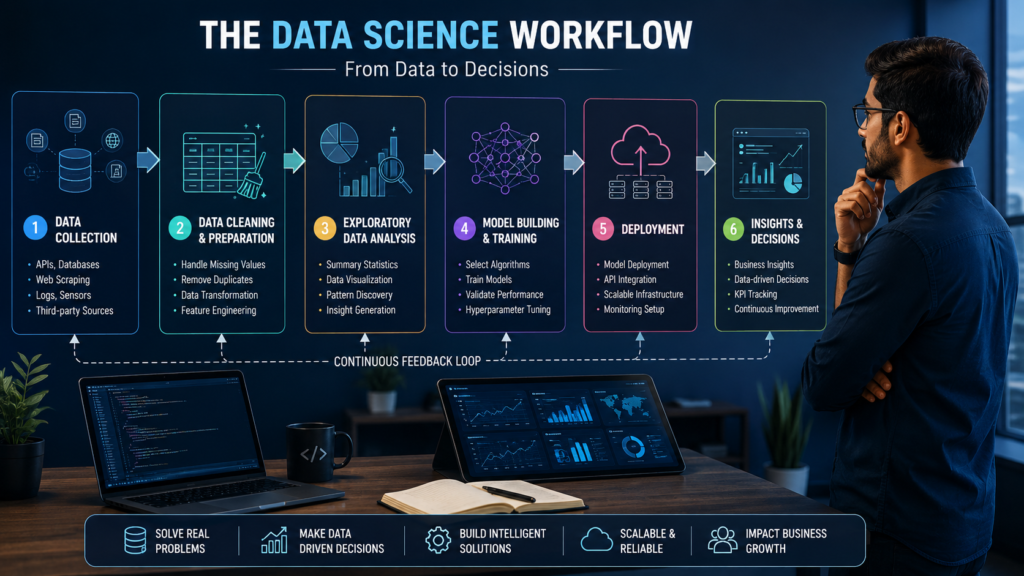
Data science is an end to end process and model development is only one stage. Reliable work begins with a clear business question and ends when the result can be used monitored and explained.
Defining the Business Problem
A team may ask for a predictive model when it actually needs a clearer metric or better reporting process. The scientist should identify the core business area and define the problem in measurable terms. This step determines what data is needed what success means and whether data science is the right solution.
Collecting and Cleaning the Dataset
Real datasets often contain missing values incorrect labels duplicate records and inconsistent definitions. Cleaning requires judgment because removing a record may improve a model while also hiding an important type of customer. The scientist should document major changes so another person can reproduce the process and understand how the final dataset was created.
Performing Exploratory Analysis
Exploratory analysis helps the scientist understand distributions relationships and unusual patterns. It can reveal that an important field is missing or that the original assumption was incorrect. This stage should not become an endless collection of charts. Each analysis should move the project closer to a useful decision.
Building Metrics
Metrics convert a broad goal into something measurable. A retention project needs a clear definition of an active user while a fraud project needs agreement about what counts as a confirmed fraudulent event. The scientist should create metrics that can be understood and used consistently across teams.
Developing and Validating Models
A scientist may develop predictive models after understanding the data and business objective. Validation checks whether the model performs well on information it did not use during training. The process should also examine whether performance changes over time or across important groups. A high accuracy score means little when the wrong metric is being optimized.
Deploying and Operationalizing Models
Operationalizing a model means making it reliable enough for real use. The team must decide how predictions will be delivered how often the model will run and what happens when data is unavailable. This stage may require close partnership with software and data engineering teams. A model that only works inside a notebook has not yet become part of a business process.
Qualifications and Portfolio Evidence
The BLS Data Scientists profile states that data scientists typically need at least a bachelor’s degree in mathematics statistics computer science or a related field. Some employers prefer a master’s degree or doctorate. Industry experience may also be useful for specialized positions.
Degree Versus Practical Experience
A degree can provide structured education in mathematics, programming and research methods. It does not automatically prove that an applicant can work with unclear business problems or communicate findings effectively. Career changers and self taught candidates may become competitive through strong foundations and well explained projects. Each employer can set its own education requirements so applicants should review the listing carefully.
Portfolio Projects That Demonstrate Ability
A useful project starts with a realistic question. Examples may include forecasting demand evaluating an experiment studying customer retention or detecting unusual transactions. The project should explain where the data came from, how it was cleaned and why a particular method was selected. It should also explain how the result could support a real decision.
Presenting a Data Science Project
Begin with the problem rather than the model. Explain the dataset, important limitations, analytical method and result. Include what did not work and what you would improve. Hiring managers may learn more from a thoughtful discussion of tradeoffs than from a perfect accuracy score.
Git Hub Notebooks and Dashboards
A GitHub repository can show code quality and project structure. A notebook can explain the analytical process while a dashboard can demonstrate visualization and metric design. Every project should include a clear README setup instructions and a short explanation of the business question. Remove broken links and unfinished work before sharing the portfolio.
Avoiding Copied Projects
Tutorials are useful for learning but copied projects do not demonstrate independent judgment. Interviewers may ask why a model was selected, why certain records were removed or how the approach would change with new data. Choose fewer projects and explain them deeply. Quality creates more trust than a large collection of unexplained notebooks.
Are Entry Level Remote Data Science Jobs Available?
Entry level remote roles exist but they often attract many applicants. Employers may prefer people who can manage tasks independently because remote supervision requires clear communication and structured onboarding.
Why Entry Level Remote Roles Are Competitive
New graduates may understand statistics and programming but have limited experience with incomplete data and changing business requirements. Employers want evidence that a candidate can ask useful questions receive feedback and document progress. A strong portfolio or internship can reduce uncertainty by showing how the applicant approaches a complete project.
Roles New Graduates Should Target
Relevant titles may include Data Science Intern, New Grad Data Scientist Associate Data Scientist Junior Data Scientist and Data Science Analyst. Candidates can also consider data analyst business intelligence and research analyst positions. These roles can build experience with SQL metrics and stakeholder communication. The best first role is one that provides useful experience. It does not need to have the perfect title.
Can a Data Analyst Become a Data Scientist?
Yes. Data analysis provides several transferable skills. An analyst may already understand data quality business metrics SQL and dashboards. Adding statistics experimentation and predictive modeling can support a gradual transition into data science. This path may be more realistic than waiting for a highly specialized machine learning role.
Building Experience Without a Full Time Role
Candidates can use public data to answer realistic questions. They may also contribute to an open source project or support a community organization with a defined analytical task. The goal is to demonstrate a process that includes problem definition data preparation analysis validation and communication. A complicated model without context provides weaker evidence.
Is Data Science Still Worth It in 2026?
Data science remains valuable for people who enjoy analytical work programming and business problem solving. The occupation is changing as artificial intelligence tools automate parts of coding and reporting. This increases the importance of judgment, validation and communication.
Current Career Outlook
The U.S. Bureau of Labor Statistics projects employment of data scientists to grow by 34 percent from 2024 through 2034. It also projects about 23,400 openings each year on average during that period. These figures cover the overall US occupation and are not limited to remote positions. The projection does not guarantee that every applicant will quickly receive an offer. Location experience education and specialization still affect individual opportunities.
Is AI Replacing Data Scientists?
AI is changing how data scientists work. It can help draft code summarize documents and explore possible methods. AI does not decide which business problem deserves attention or whether a dataset represents reality. It also cannot remove the need for accountability when a recommendation creates risk. Current employment projections suggest that the occupation is changing rather than disappearing.
Human Judgment and AI Risk
The NIST AI Risk Management Framework is designed to help organizations manage risks associated with developing and using AI systems. Data scientists may help evaluate model quality bias reliability and intended use. AI can support this work but accountability remains with people and organizations.
Skills That Remain Valuable
Statistics experimental design, data quality and business understanding remain valuable even when AI helps generate code. Employers still need professionals who can challenge assumptions and communicate uncertainty. Candidates should learn to use AI tools responsibly without allowing generated output to replace understanding.
Benefits and Challenges of Remote Data Science Work
Remote work can improve access to employers and provide a focused environment for analytical work. It can also create communication delays, security restrictions and weaker separation between work and personal time.
Access to a Wider Job Market
A remote position can allow candidates to apply to employers outside their local city. This can help people who do not live near a major technology or business hub. Location restrictions still matter because many remote employers can only hire in approved states or countries.
Focused Analytical Work
Data cleaning, coding and model development often require uninterrupted concentration. A well organized home workspace can support deeper focus than a busy office. The benefit depends on reliable internet suitable equipment and clear expectations from the employer.
Remote Collaboration Challenges
Distributed teams may experience delayed feedback and unclear responsibilities. A scientist may need information from product or engineering before continuing. Poor communication can delay the project. Written documentation and regular updates help teams reduce unnecessary confusion.
Data Security and Privacy
Data science may involve customer financial or healthcare information. Companies may require secure devices approved cloud environments and strict access controls. A remote employee must follow the same security standards as an office employee. Sensitive information should not be downloaded to personal systems or shared through unapproved tools.
Remote Data Scientist Salary and Compensation
There is no single salary range that applies only to remote data scientists. Compensation changes according to experience industry location education and level of responsibility. The latest O*NET national wage data based on BLS 2025 wage information shows $120,230 at the 50th percentile. It lists $67,240 at the 10th percentile and $199,130 at the 90th percentile. These figures cover the overall US data scientist occupation and are not remote specific.
What Affects Remote Data Science Pay?
Experience has a major effect on compensation. Specialization also matters. A senior scientist responsible for financial risk or production machine learning may receive a different package from an associate scientist supporting reports. Industry company size location rules leadership responsibility and security requirements can also affect pay.
Entry Level and Associate Compensation
Entry-level compensation is often below the occupation wide midpoint because national wage figures include experienced professionals. Applicants should evaluate training mentorship benefits and project quality alongside salary. A slightly lower offer may provide stronger long-term value when the role offers meaningful analytical ownership and experienced guidance.
Senior Staff and Leadership Compensation
Senior staff, lead and management roles may provide higher base salaries. Some employers also offer bonuses, equity or profit based compensation. Higher pay usually comes with broader responsibility. The scientist may become accountable for model quality project direction and decisions that affect several teams.
Base Salary Versus Total Compensation
Base salary is the regular cash payment for a role. Total compensation may include bonuses equity retirement contributions health coverage and other benefits. Candidates should ask how equity vests and whether a quoted figure represents guaranteed cash or the complete estimated package.
Contract Rate Versus Full Time Salary
A contract rate may appear higher than a salaried amount. A contractor may not receive paid leave health insurance, retirement benefits or long term job security. Estimate annual earnings and expected expenses before comparing a contract offer with a full time position.
How to Evaluate a Remote Data Science Job Listing
A useful job listing explains the business area main responsibilities and expected technical skills. A vague title with an attractive salary is not enough information.
Confirm That the Role Is Remote
Check the approved state, country and time zone. Look for required office visits travel and in-person onboarding. Remote eligible may not mean fully remote. If the work arrangement is important to you confirm it before accepting an offer.
Understand the Business Problem
Review the product or decision that the scientist will support. A marketing role requires different knowledge from healthcare research or financial fraud. The BLS notes that some employers require industry related experience or education for specialized data science work.
Match the Technical Requirements
Separate required skills from preferred skills. A candidate does not need to match every secondary tool. The core responsibilities should still align with experience that can be demonstrated. Avoid applying to production heavy machine learning roles when your portfolio contains only introductory notebooks.
Review Deployment Expectations
Some roles focus mainly on analysis and experimentation while others require model deployment cloud systems data pipelines and production monitoring. Check whether the data scientist owns deployment or works with engineering teams. This difference can significantly change the skills required for the position.
Check Seniority and Ownership
Words such as lead mentor define strategy and oversee model development often indicate an experienced position. A general job title may hide staff level responsibilities. Compare the scope with projects you have already completed.
Confirm Employment Type and Pay
Check whether the position is full time contract temporary or consulting. Review the salary range benefits equipment support working hours and on call expectations. Save a copy of the listing so you can compare the final offer with the original description.
Where to Find Legitimate Remote Data Science Jobs
Job platforms can help candidates discover opportunities. The employer’s official career page should be used to confirm that a role is genuine and still available.
Official Employer Career Pages
An official career page provides the original job description. It may also explain benefits location rules and the application process. When you find a position elsewhere search for the same title on the company website before submitting sensitive personal information.
Reputable Job Platforms
Established job platforms allow candidates to search by role location and seniority. Use several search terms because related positions may appear under titles such as Data Scientist Decision Scientist Product Analyst or Machine Learning Scientist. A recognized platform does not guarantee that every listing is current or legitimate. Verification is still necessary.
Remote First and Startup Job Boards
Remote first boards can be useful for discovering distributed companies. Startup roles may offer wider responsibility and faster learning but they can also provide less structure. A startup may expect one person to manage several stages of a project. Review the company benefits and workload before applying.
Professional Networks and Data Communities
Professional networks can help candidates learn about teams and hiring plans. Sharing projects, writing clear case studies and contributing to professional discussions may improve visibility. A referral can help an application receive attention but it should never require payment.
Verify the Job Before Applying
Search for the company name and position independently. Check the recruiter’s email domain and confirm that the role appears on the official employer website. The Federal Trade Commission advises job seekers not to pay for the promise of employment. The FTC has also warned about fake recruiters offering vague remote jobs and eventually asking applicants to send money.
How to Apply for Remote Data Science Jobs
A strong application connects the candidate’s experience with the problem described in the listing. It should not repeat the same generic skill list for every employer.
Tailor the Resume
Highlight projects that match the role. A product position should show experiments metrics and user behavior work. A fraud position should show risk analysis and model evaluation. The first part of the resume should make the connection clear.
Show Measurable Results
Explain what the project discovered or improved. A useful result might involve reducing processing time improving forecast accuracy or helping a team make a better decision. Only use numbers that are accurate and can be explained during an interview.
Present Technical Findings Clearly
A resume should not become a list of programming tools. Describe the question, method and result in clear language. A hiring manager should understand why the project mattered even without reading every line of code.
Include Relevant Portfolio Evidence
Link to a small number of strong projects. Confirm that the code works and the documentation is clear. Do not make the reviewer search through dozens of repositories to find relevant evidence.
Track Applications
Record the company role submission date and application status. Save the job description because the page may disappear before the interview. Tracking also helps candidates identify which types of roles generate responses.
How Remote Data Science Hiring Works
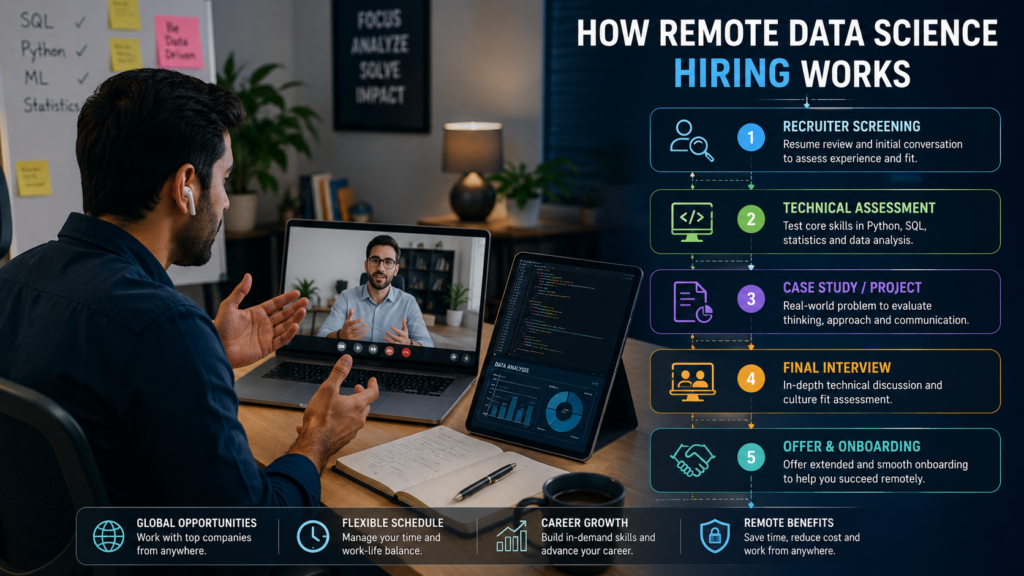
Employers may use several stages to evaluate technical skill business judgment and communication. The exact process changes according to the company and seniority level.
Recruiter Screening
The first conversation may cover location, work authorization salary expectations and availability. The recruiter may also ask for a short explanation of your background. Prepare a clear description of the problems you have solved and the type of role you are targeting.
SQL and Python Assessment
Candidates may be asked to clean data write queries or complete a programming exercise. Readable work is usually better than unnecessary complexity. Check the result and explain your assumptions. A correct answer without reasoning may not show how you would approach real analytical work.
Statistics and Machine Learning Interview
Questions may cover sampling, experiment design model evaluation bias or overfitting. Explain why a method is suitable rather than giving only a definition. Senior candidates may also be asked how they would monitor a model or respond when its performance begins to decline.
Data Science Case Study
A case study may provide a business problem and a sample dataset. The candidate may need to define metrics recommend an approach and explain how success would be measured. Ask clarifying questions before selecting a model. The interviewer may be testing problem definition as much as technical ability.
Product and Stakeholder Interview
This stage checks whether a candidate can work with people outside data science. The interviewer may ask how you would handle unclear requirements or explain an uncertain result to a product manager. Strong answers show technical honesty and offer a practical next step.
Final Offer and Remote Terms
Confirm the salary benefits working hours and approved location. Ask about equipment data access meeting expectations and performance reviews. Make sure the remote arrangement in the offer matches what was described during the hiring process.
How to Prepare for a Remote Data Science Interview
Preparation should match the position. Trying to review every possible data science topic can waste time and create shallow answers.
Review Statistics and Experimentation
Practice explaining probability confidence intervals hypothesis testing and experiment design. Use practical examples instead of memorized definitions. Be ready to discuss what could invalidate a result and how you would investigate an unexpected outcome.
Practice SQL and Python
Review joins grouping window functions and common data cleaning tasks. Write code that another person can understand. Interviewers may ask you to explain your approach while working so practice discussing your reasoning clearly.
Prepare End to End Projects
Select two or three projects that demonstrate problem definition, data preparation analysis validation and communication. Understand the limitations of each project. Be ready to explain what failed and what you would change with more time or better data.
Practice Business Communication
Explain one project to a technical interviewer. Then explain the same project to a nontechnical manager. The language can change but the facts should remain consistent.
Test the Remote Setup
Check the internet connection camera microphone screen sharing and meeting software. Confirm that your coding environment works before the interview. Keep a backup contact method available in case the call fails.
Common Mistakes Remote Data Science Applicants Make
Strong technical knowledge can be weakened by a generic application or poorly explained portfolio. Avoiding common mistakes can improve the credibility of an application.
Using the Same Resume for Every Role
A generic resume forces the employer to guess why the candidate is relevant. Adjust the project order and descriptions to match the business area. The facts should remain accurate while the most relevant evidence appears first.
Listing Machine Learning Without Evidence
Writing machine learning on a resume does not prove practical ability. Show the dataset problem evaluation method and result. Explain why the model was selected and what limitations remained.
Ignoring Business Impact
A technically impressive model may provide little value when it does not support a decision. Connect every major project with a real objective. Explain what a product operations or leadership team could do with the result.
Using Only Clean Tutorial Data
Tutorial datasets are helpful for learning. Real work includes missing information, changing definitions and unexpected errors. A portfolio should eventually demonstrate how a candidate handles uncertainty and imperfect data.
Hiding Model Limitations
Every model has limitations. Candidates lose credibility when they present a result as perfect. Discuss assumptions weaknesses and possible risks. This demonstrates mature analytical judgment.
Trusting Unverified Recruiters
A professional looking message can still be fraudulent. Verify the company and recruiter through official sources. Do not pay for training equipment or interview access. Unexpected messages that offer vague remote work and unusually easy income should be treated cautiously.
Can I work remotely in data science?
Yes. Many analytical tasks can be completed through cloud platforms databases programming tools and online collaboration. Some employers still restrict remote work by state country or time zone. Check the location requirements before applying.
What types of remote data science jobs are available?
Common roles include product data scientist machine learning data scientist fraud data scientist pricing data scientist marketing data scientist decision scientist and research data scientist. Career levels range from internships and associate roles to staff lead and manager positions.
Are there entry level remote data science jobs?
Yes but competition can be high. Search for titles such as Data Science Intern New Grad Data Scientist Associate Data Scientist Junior Data Scientist and Data Science Analyst. A well explained portfolio can help demonstrate that you are ready to work independently.
What skills are needed for remote data science work?
Important skills include Python SQL statistics data cleaning machine learning experimentation and visualization. Remote professionals also need documentation communication and stakeholder management skills.
Is AI replacing data scientists?
AI is automating parts of coding and reporting but it does not remove the need to define problems validate data evaluate risk and communicate decisions. Current BLS projections still show strong expected growth for the data scientist occupation.
Is data science still worth it in 2026?
It can remain a valuable career for people who enjoy statistics programming and decision making. The BLS projects 34 percent growth in data scientist employment from 2024 through 2034. Individual success still depends on skills experience and application quality.
Is 40 too late to start a data science career?
There is no fixed age that makes it too late to enter data science. Career changers should build the required technical foundations and create projects that demonstrate practical ability. Previous industry experience may become an advantage when it helps the candidate understand a specialized business area.
How can I find legitimate remote data science jobs?
Use established job platforms for discovery and confirm each role through the employer’s official career page. Verify the recruiter and email domain. Never pay for the promise of employment or send money after receiving a company check.
What Is the Salary Range for Remote Data Scientists?
There is no official remote only salary range. O*NET’s national wage table using BLS 2025 data lists $67,240 at the 10th percentile $120,230 at the 50th percentile and $199,130 at the 90th percentile for the overall occupation. Actual compensation depends on experience industry location and level of responsibility.
Conclusion
Remote data science jobs cover product analytics machine learning, fraud detection pricing research and business decision support. The strongest candidates understand more than programming. They can define a useful question prepare complex datasets select appropriate methods and validate results before communicating clear recommendations. Choose a role that matches your current experience and build portfolio projects that show an end to end analytical process. Review the location salary deployment expectations and seniority before applying. Use job platforms to discover opportunities but confirm each role through the employers official website. A focused application and a well explained project will normally create a stronger impression than a long list of tools without supporting evidence.

1 Comment
Pingback: No Phone Remote Jobs Work From Home Roles Without Constant Phone Calls