


Remote product manager jobs allow professionals to lead products without working from the same office as every engineer designer or stakeholder. The location changes but the core responsibility remains the same. A product manager must understand customer problems and help a team decide what to build why it matters and how success will be measured. The best remote product manager jobs are not simply meeting heavy roles with flexible locations. Employers expect product managers to understand users make tradeoffs use analytics and turn product strategy into work that engineering and design teams can execute.
Remote work also creates additional challenges. A role advertised as remote may still be limited to certain states or time zones. Product managers also need stronger written communication because decisions must remain clear when teams work asynchronously. This guide explains the main remote PM specializations career levels skills salary expectations and hiring process for US job seekers in 2026. Readers comparing broader technology careers can also use our remote IT jobs guide.
What Are Remote Product Manager Jobs?
A remote product manager helps a company identify customer problems and decide which product opportunities deserve investment. The manager may lead discovery define product strategy prioritize a roadmap and work with engineering and design through delivery. The work is broader than maintaining a feature list. Strong product managers understand the market and discover customer needs before committing expensive development time. They also measure outcomes after launch to determine whether a product actually created customer value. Remote PMs perform these responsibilities across distributed teams. This makes written decisions clear ownership and cross functional alignment especially important.
Fully Remote Remote Eligible and Hybrid Product Roles
Fully remote does not always mean work from anywhere. Some employers allow a product manager to work from any US state where the company is registered. Others restrict hiring to certain regions or require employees to overlap with a particular time zone. For example a current Smartsheet Product Manager II Growth role is remote eligible across US locations where Smartsheet is a registered employer. The listing also expects close work with engineering design research, analytics and other teams.
A hybrid role usually requires regular office attendance. Remote eligible may mean the employee can work from home but only under specific location or team rules. Always check the location section instead of assuming that the word remote removes geographic restrictions.
Product Manager Versus Product Owner
A Product Manager usually owns a wider business and customer problem. The role may include research, positioning prioritization roadmap decisions and measurement. A Product Owner often works closer to the delivery team. The role may focus more heavily on backlog management requirements and helping a development team understand what should be built next. Companies use these titles differently. Some Product Owners perform work that looks very similar to product management. Applicants should compare responsibilities rather than choosing roles based only on titles.
Product Manager Versus Project Manager
A Product Manager focuses on what should be built and why. A Project Manager focuses more on how work is organized and delivered within scope schedule and resource constraints. The distinction matters when applying. A strong project management background can provide useful skills but a product interview may require deeper evidence of customer discovery product judgment and outcome based prioritization. Candidates moving between the two fields should show how their previous work influenced product decisions rather than only describing schedules and coordination.
Types of Remote Product Manager Jobs
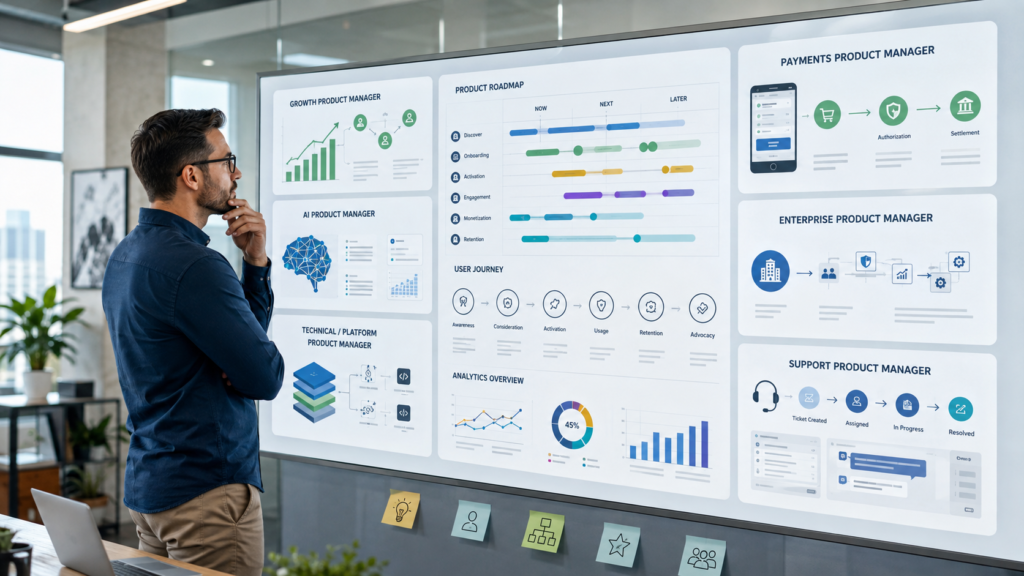
Product management now includes several distinct specializations. The top remote product manager jobs may focus on growth technical platforms AI payments or internal enterprise systems. Choosing a specialization that matches your existing experience can make an application much stronger than applying to every role with Product Manager in the title.
Core Product Manager and Product Manager II
A core Product Manager usually owns a customer problem or product area. The manager may lead product strategy and execution from discovery through launch and measurement. A Product Manager II title often indicates greater independence than an entry level PM role. The person may own a meaningful roadmap and present decisions directly to senior stakeholders. The numbering is company specific. Product Manager II at one employer may have responsibilities similar to a standard Product Manager or Senior Product Manager somewhere else. Look at ownership experience requirements and decision making authority before judging the level.
Growth and Acquisition Product Manager
A Growth Product Manager focuses on measurable customer behavior such as acquisition activation conversion retention or expansion. The role often uses experimentation and analytics to identify opportunities. A growth PM may test onboarding changes improve marketplace conversion or reduce friction inside a purchase flow. KPIs matter here but a good growth PM does not optimize a number without considering the customer experience. Short term conversion can improve while long term retention becomes worse. The strongest candidates can connect an experiment with a clear hypothesis and measure outcomes after release.
Technical and Platform Product Manager
A Technical Product Manager works closely with engineering teams on systems that may not have an obvious consumer facing interface. The product could be an API developer platform admin platform or core infrastructure layer. Technical PMs may discuss product architecture and reliability with engineers while still keeping the roadmap connected to user or business value. Some infrastructure environments involve concepts such as Kubernetes observability service mesh SRE practices or capacity planning. A PM does not need to be the engineer implementing these systems but must understand enough to make informed tradeoffs.
Candidates interested in engineering heavy product work may also find our remote software engineering roles guide useful for understanding adjacent technical careers.
AI and Data Product Manager
AI Product Managers help teams decide where machine learning or generative AI can solve a meaningful problem. The job is not simply to add AI enabled features. A strong PM needs to understand the user problem and determine how quality will be evaluated. They should also consider failure modes adoption and whether the AI experience creates more value than a simpler solution. Data products may involve analytics recommendation systems or internal decision tools. Platform focused roles can also involve enhancing MLOps capabilities so teams can deploy and evaluate models more reliably. A current Smartsheet senior AI platform role owns a roadmap covering model serving infrastructure agent orchestration quality measurement and governance.
This shows how technical AI product management can extend far beyond interface features. Readers who prefer building and analyzing models directly can compare this path with our remote data science jobs guide.
Payments Fintech and Compliance Product Manager
Payments product work can involve the complete payment lifecycle from checkout through processing reconciliation and reporting. A PM may work on payments core infrastructure or help optimize payment funnels. More complex systems can include multi partner routing and failover when one provider becomes unavailable. Fintech products may also require transaction monitoring suspicious activity detection and risk based workflows. This is where product decisions meet compliance obligations. A strong PM must partner with compliance teams without treating compliance as a final approval step. Regulatory requirements can affect product design from the beginning.
Enterprise Admin and RevOps Product Manager
Enterprise product managers often build tools for larger organizations with complex workflows. The product may focus on enterprise readiness permissions admin workflows or integrations with finance and customer systems. RevOps product work can connect sales processes with billing customer data and financial reporting. Core apps may also need integrations with platforms used by finance or operations teams. These roles require careful stakeholder management because several internal teams may depend on the same workflow.
Support and Operations Product Manager
A Support Product Manager improves the tools and workflows used by customer support or internal operations teams. The support product may include ticket routing agent tools knowledge systems self service experiences or automation. A good PM studies both employee pain points and customer outcomes. Faster ticket handling is useful but not when it produces lower quality resolutions. Operations PMs often work across several departments. Clear prioritization becomes important because internal requests can grow faster than engineering capacity.
Remote Product Manager Role Comparison
| Remote PM Role | Main Focus |
| Core Product Manager | Product strategy and feature execution |
| Growth Product Manager | Acquisition retention and conversion |
| Technical Product Manager | Platforms APIs and infrastructure |
| AI Product Manager | AI enabled products and evaluation |
| Payments Product Manager | Payments risk and compliance |
| Enterprise Product Manager | Business systems and integrations |
| Support Product Manager | Support tooling and operations |
Remote Product Management Career Levels
Product management levels vary significantly between employers. A title alone does not tell you how much ownership a role carries. The better approach is to compare decision authority, roadmap scope and leadership expectations.
Associate Product Manager and Entry Level Roles
Associate Product Manager roles are one path into the field. They may involve smaller product areas and closer guidance from experienced PMs. Entry level remote positions can be competitive because distributed teams often value people who can communicate clearly and work independently. Candidates without formal PM experience should show evidence of customer research, prioritization and measurable product thinking. Experience from engineering design analytics operations or customer success can also transfer into product management when presented correctly.
Product Manager I and Product Manager II
A Product Manager I may own a defined feature area with regular support. A Product Manager II may work more independently and lead roadmap decisions across multiple releases. The role may also require direct communication with senior stakeholders. Current job descriptions show that Product Manager II positions can expect several years of previous PM experience rather than functioning as entry level jobs. Smartsheet currently asks for at least three years of product management experience for its remote eligible Growth PM II role.
Senior Staff and Principal Product Manager
Senior Product Managers usually own larger problems and more ambiguous product areas. Staff and Principal PMs may influence strategy across several teams without becoming people managers. Their work often involves long term product direction and complex tradeoffs. At these levels owning multi quarter roadmaps is common. Strong candidates need to show that they can shape investment priorities rather than only oversee feature execution.
Group Product Manager and Product Leadership
A Group Product Manager may lead several related product areas and may also mentor PMs. The role requires broader product judgment because decisions can affect multiple teams. Group PMs may lead multi year strategy and drive cross functional alignment across engineering design and business leadership. Some companies use other titles such as Senior Product Builder for similar high ownership work. The responsibilities are more important than the label.
What Do Remote Product Managers Actually Do?
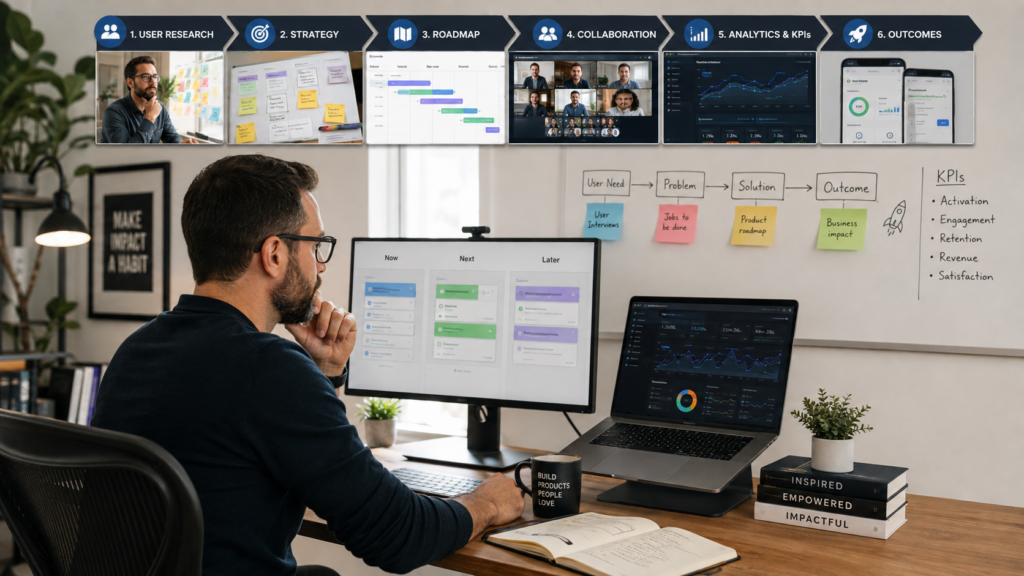
Product management can look different from one company to another but the strongest roles share a common pattern. The PM identifies a valuable problem and helps the team make better decisions from discovery through measurement. Remote work makes this process more explicit because decisions need to survive beyond meetings.
Discover Customer Needs and Lead User Research
Product work should begin with understanding the customer. A PM may review support data conduct interviews or partner with UX researchers. The goal is to discover customer needs rather than start with a preferred feature. Good research also tests assumptions. A request that sounds common may only affect a small customer group or may hide a deeper problem. The PM should validate solutions before committing major engineering resources whenever possible.
Define Product Vision and Roadmap
A product vision explains where the product should go and why that direction matters. More experienced PMs may own a product vision and multi year roadmap while balancing shorter term needs. They decide which problems deserve attention and which requests should wait. A roadmap should not become a promise to deliver every idea on a fixed date. It should communicate priorities and the outcomes the team wants to create. Strong PMs prioritize roadmaps based on evidence and customer value rather than whoever makes the loudest request.
Partner With Engineering and Design
A PM cannot build a strong product alone. They partner with engineering to understand technical constraints and opportunities. They also partner with design to improve UX and test whether a proposed experience makes sense to users. Good collaboration does not mean telling engineers exactly how to implement every feature. The PM defines the problem and helps prioritize engineering work. Engineering brings technical expertise while design brings interaction and research expertise. The best decisions emerge when these disciplines challenge each other respectfully.
Use Analytics and KPIs to Measure Outcomes
Shipping a feature is not proof that the product improved. Product managers use analytics and KPIs to understand whether customer behavior changed after release. The correct metric depends on the problem. A growth feature may focus on activation or conversion while an infrastructure product may track reliability adoption or incident reduction targets. Strong PMs define success before launch. This reduces the temptation to select a flattering metric after seeing the result.
Drive Cross Functional Alignment
Product managers frequently work with teams they do not directly manage. They may collaborate cross functionally with engineering design marketing sales finance compliance and customer success. The PM needs to explain what the team is doing and why. When priorities change they should make the tradeoff visible rather than leaving teams to guess. This ability becomes especially important in remote environments because misunderstandings can remain unnoticed for longer.
Skills Employers Look for in Remote Product Managers
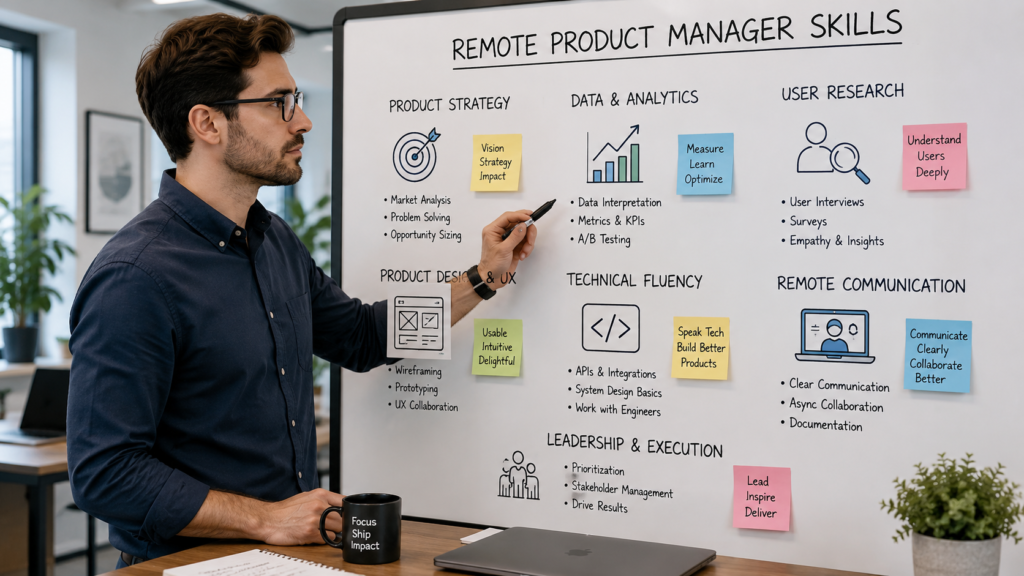
Remote PM hiring combines traditional product skills with the ability to lead without relying on constant meetings. Strong applicants show how they make decisions and influence teams rather than simply listing tools on a resume.
Product Strategy and Prioritization
A PM should be able to define strategy and translate it into practical priorities. That means deciding which problem to solve first and which opportunities should not receive engineering time. Candidates should prepare examples where they made a difficult tradeoff and explain what evidence influenced the decision.
Customer Research and UX Judgment
Product managers need enough research ability to understand users and enough UX judgment to recognize when an experience creates unnecessary friction. They do not have to replace professional researchers or designers. The PM should know how to frame a useful research question and interpret customer feedback without treating every request as a requirement.
Analytics and Experimentation
Product managers should be comfortable using data to challenge assumptions. This may include funnel analysis cohort behavior experiments or adoption metrics. A growth PM may need deeper experimentation skills while an enterprise PM may rely more heavily on qualitative evidence and account level usage. The important skill is connecting evidence with a product decision.
Technical Fluency
Technical fluency helps PMs work more effectively with engineers. The required depth depends on the product. A consumer PM may need a general understanding of APIs and system constraints. A platform PM may need much stronger knowledge of architecture and infrastructure. Technical fluency should improve communication rather than encourage the PM to override engineering expertise.
Written Communication and Remote Leadership
Remote teams need decisions that remain understandable after a meeting ends. A PM should be able to write a clear product brief and document assumptions. They should also explain why a priority changed and what decision is still unresolved. Good remote leadership creates clarity without turning every issue into another video call.
AI Fluency for Product Managers
AI fluency is increasingly useful across product roles. Current PM postings include explicit expectations around using AI tools or building AI powered workflows. Smartsheet’s current Growth PM II role even mentions the ability to use AI tools while still applying human judgment about where AI adds real value. The strongest skill is not knowing every new AI product. It is understanding where AI can improve a workflow and how to evaluate whether it actually works.
Benefits and Challenges of Remote Product Management
Remote product management can widen the job market and offer more flexibility. It also removes some of the informal communication that product teams rely on in an office. Candidates should consider both sides before deciding that remote work is automatically better.
Access to Employers Outside Your City
Remote work allows product managers to consider employers outside their immediate area. This can be valuable for people who do not live near a major technology hub. It does not eliminate eligibility rules. Employers may still restrict hiring by state country or time zone.
Time Zone and State Restrictions
A US remote role may require working hours that overlap with a team based on the West Coast or East Coast. Companies may also hire only in states where they are set up to employ workers. Review these requirements before spending time on a long application or case study.
Cross Functional Communication Challenges
Remote PMs cannot depend on casual office conversations to keep everyone aligned. An engineer may interpret a requirement differently while a sales team may continue discussing an outdated roadmap. Documentation and clear ownership reduce this risk. The PM should make important decisions easy to find and explain what changed.
Visibility Ownership and Accountability
Remote work can make invisible work easier to overlook. Product managers should communicate progress without creating unnecessary status meetings. Strong remote PMs keep decisions risks and outcomes visible. They take responsibility when an assumption proves wrong and update the plan based on new evidence.
Remote Product Manager Salary and Compensation
There is no single salary that accurately represents all remote product managers. Current US postings show major differences between standard PM senior PM and principal level positions. Compensation can also change by location and specialization.
What Affects Remote Product Manager Pay?
Experience is one factor but scope can matter just as much. A PM responsible for a narrow product feature may have a different compensation range from a senior PM leading a technical platform. Company size, industry and geographic pay strategy also matter. Some employers use different compensation zones even when the work itself is remote.
Mid Level Versus Senior Product Manager Compensation
Current official job listings show how much compensation can vary by company and product scope. Remote currently lists a Senior Product Manager Remote Build role with a base salary range of $149,750 to $168,500. Webflow currently lists a US Remote Senior Product Manager AI role with base pay ranging from $165,000 to $225,000 depending on geographic pay zone. These examples are not universal salary ranges and applicants should always check the compensation listed for their location.
Base Salary Bonus and Equity
Base salary is only one part of a product manager offer. Some companies add performance bonuses or equity. Senior roles at startups and public technology companies may place more value in equity than positions at other employers. Candidates should understand vesting terms and whether a compensation figure represents guaranteed cash or estimated total compensation.
Why Remote Salary Can Depend on Your Location
Remote work does not always create location-independent pay. Webflow currently publishes different US compensation zones for its remote-first Senior Product Manager Developer Productivity role. The listed ranges vary from $165,000 to $225,000 depending on geographic zone. This is why applicants should review the salary disclosure for their actual location before comparing offers.
Where to Find Legitimate Remote Product Manager Jobs
Finding openings is only the first step. Remote job seekers also need to confirm that a listing is current and that the recruiter is legitimate. The employer’s official career page should be the final verification point whenever possible.
Official Employer Career Pages
Official career pages are useful because they show the employer’s current description and application process. As of this guide’s 2026 update Smartsheet’s official product careers page includes remote US product roles such as Product Manager II Growth and senior AI platform product management. Remote also has current fully distributed Senior Product Manager roles and describes its workforce as globally remote. These examples can change quickly. Do not treat a company name in an article as proof that the same vacancy will still exist next month.
Established Job Platforms
Major job platforms are useful for discovery because they allow filtering by title location and seniority. Search more than one title. A relevant role may appear under Product Manager Product Manager II Technical Product Manager Growth Product Manager or Senior Product Manager. When a platform shows a promising position check whether you can find the same vacancy on the employer’s own career site.
Remote First and Startup Job Boards
Remote first and startup boards can uncover specialized roles that are easier to miss in broad searches. These companies may use less traditional titles and may expect one PM to cover discovery, analytics and execution. Read the scope carefully. A startup Product Manager can sometimes carry responsibilities that a larger company would divide across several roles.
How to Set Up Job Alerts
Create separate alerts for the titles that actually match your background. A candidate interested in platform products may create alerts for Technical Product Manager and Platform Product Manager rather than relying only on a broad Product Manager search. Use location filters carefully. One alert can target Remote US while another can cover a specific state if you are open to hybrid opportunities. Alerts reduce manual searching but they do not replace verification.
How to Verify a Remote Job Before Applying
Confirm the role on the employer’s official site and inspect the recruiter’s email domain. The Federal Trade Commission’s work from home scam guidance says job seekers should research the company and never pay for the promise of a job. The FTC also warns that fake checks and requests to purchase equipment with transferred money are common scam patterns. In April 2026 the FTC also warned about unexpected texts offering vague remote positions before eventually asking victims for money.
How to Apply for Remote Product Manager Jobs
A good product application should demonstrate judgment and outcomes. A resume filled with phrases such as managed roadmap or worked cross functionally gives the employer little evidence of how the candidate actually thinks.
Tailor Your Resume to Product Outcomes
Start with the problems you owned and the outcomes you helped create. A growth PM should emphasize experimentation and conversion. A platform PM should highlight adoption reliability or developer experience. Do not copy the job description into the resume. Show relevant evidence from your own work.
Show Product Impact With Metrics
Metrics can make an achievement more credible when they are accurate. A product bullet might show increased adoption or improved conversion. Infrastructure work may show lower incident volume or faster integration. Do not invent numbers because they sound impressive. If an outcome cannot be quantified explain the decision or customer problem that changed because of your work.
Show How You Worked With Engineering and Design
Employers want evidence that a PM can collaborate with engineering without acting like an engineering manager. Describe how you framed the problem and made tradeoffs. Explain how design research influenced the solution and how technical constraints changed the plan. Strong examples show shared decision making rather than a PM giving orders.
Build a Strong Product Portfolio or Case Study
A portfolio can be useful for career changers and candidates who need more evidence than a resume provides. Choose a realistic product problem and explain how you would investigate it. Show the customer problem, evidence possible solutions and success metrics. Avoid presenting an attractive redesign without showing why the redesign is needed. Product management is about decisions rather than visual polish alone.
Match Your Experience to the Product Area
A candidate with payments experience should not hide that knowledge when applying to a fintech company. Someone with infrastructure experience may have a stronger story for a platform role than for a consumer growth position. Specialization can reduce the number of jobs you apply to but improve the quality of each application.
How Companies Hire Remote Product Managers
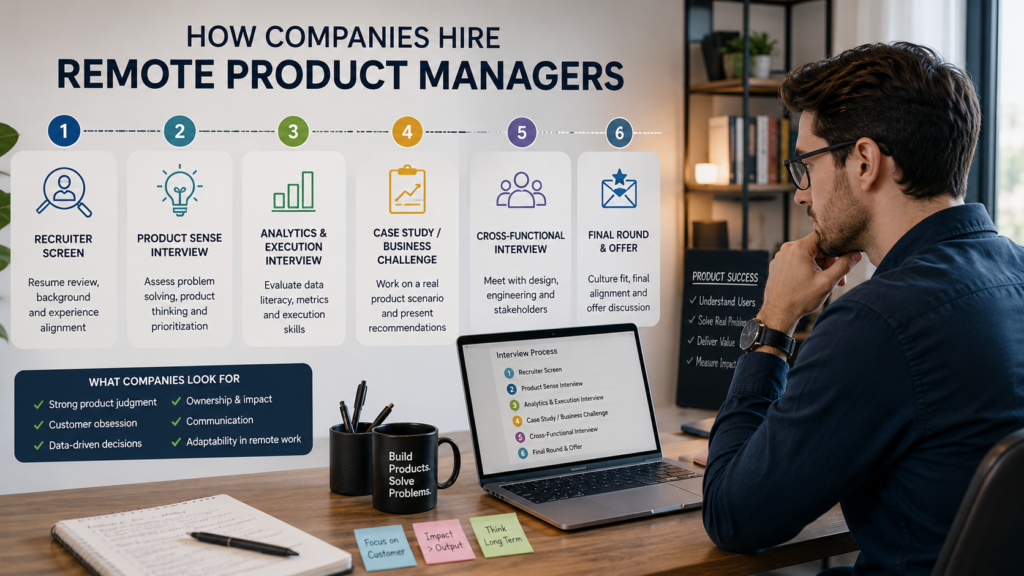
Companies hiring remote product managers often use several interviews because they need to evaluate product judgment execution and collaboration separately. The exact sequence varies. Applicants should prepare for the underlying skills rather than memorizing one interview framework.
Recruiter Screening
The first conversation often covers experience location and compensation expectations. The recruiter may also confirm whether the company can employ someone in your state. Prepare a short explanation of your product background and the types of problems you have owned.
Product Sense Interview
A product sense interview examines how you understand users and identify problems. You may be asked to improve an existing product or design a solution for a particular audience. Do not jump directly to features. Clarify the user and problem first. Then explain how you would evaluate possible solutions.
Product Execution and Analytics Interview
Execution interviews often test prioritization and measurement. A question may ask which KPI you would use or how you would investigate a sudden drop in conversion. Explain the reasoning behind your choice. Interviewers usually learn more from a structured decision process than from one memorized answer.
Product Case Study or Take Home Exercise
Some companies ask candidates to prepare a case study or complete a take home assignment. Define the problem before proposing a roadmap. State your assumptions and show which questions you would validate with customers or data. Do not spend hours creating decorative slides while leaving the decision logic unclear.
Cross Functional Interview
Engineering and design partners may evaluate how you handle disagreement. The interviewer may ask about a project where technical constraints changed the roadmap or where customer research challenged your original idea. Strong answers show respect for other disciplines and explain how the team reached a better decision.
Final Offer and Remote Work Terms
Before accepting an offer confirm the approved work location, schedule expectations and compensation. Ask whether travel or regular in person events are required. Also confirm how equity, bonuses and remote work benefits operate. Hiring timelines vary because companies use different interview stages. A current Remote Senior Product Manager posting lists a multi stage process that includes recruiter hiring manager product deep dive and team interviews before final verification.
What Makes Someone Successful in a Remote Product Manager Role?
Remote PM success depends less on appearing busy and more on creating clarity. The manager must help the team understand the problem and make decisions without becoming a bottleneck.
Clear Written Decisions
Important product decisions should be easy to understand later. Good documentation explains the problem evidence and decision. It also records what remains uncertain so a future discussion does not start from zero.
Strong Product Judgment
Product judgment develops through customer understanding and repeated decisions. A successful PM knows when a complex feature is justified and when a simpler solution provides more value. They also know when more research is needed before committing resources.
Ability to Prioritize
Every product team has more possible work than available engineering capacity. Strong PMs prioritize based on customer value business impact and evidence. They can also explain why something important is not being built yet.
Cross Functional Trust
PMs rarely have formal authority over every team they depend on. Trust matters more than control. Engineers and designers should feel that the PM understands their concerns and communicates decisions honestly.
Measuring Results Instead of Shipping Features
Shipping is a milestone rather than the final outcome. A successful PM returns to the original hypothesis and checks whether behavior improved. When results are weaker than expected the team should learn from them instead of pretending that launch itself proved success.
What are the typical salary expectations for remote product managers?
There is no single remote PM salary range. Current US postings show mid level roles around the low to mid $100,000s while senior and principal roles can be much higher. Location experience product specialization and company level all affect compensation. Current examples include $121,250 to $143,750 for a Smartsheet PM II role and $171,250 to $203,750 for its senior AI platform PM role.
Where can I find remote product manager jobs?
Start with employer career pages and established job platforms. Remote first and startup job boards can also uncover specialized roles. Set alerts for multiple titles and verify the final listing through the employer’s official site.
What are the most in demand skills for remote product managers?
Important skills include product strategy prioritization customer research analytics technical fluency and cross functional communication. Remote PMs also need strong written communication because important decisions cannot depend entirely on meetings.
Are there entry level remote product manager jobs available?
Yes but they can be highly competitive. Search for Associate Product Manager and early career Product Manager positions. Candidates can strengthen applications by showing relevant work from engineering analytics customer success operations or design.
How long does it take companies to hire a remote Product Manager?
There is no universal timeline. Some companies use a few interviews while others add case studies and several cross functional stages. The process can take longer for senior roles because more stakeholders may participate.
What are the main remote product manager specializations?
Common specializations include growth technical and platform products AI and data payments and fintech enterprise systems and support operations. The strongest target is usually the specialization closest to your existing experience.
How can I get updates about new remote PM openings?
Create alerts for several relevant titles and use Remote US as a location filter where available. Employer career pages may also offer direct job alerts. Review alerts regularly because remote vacancies can close quickly.
What are the biggest challenges of remote product management?
Common challenges include time zone differences, unclear written communication and reduced informal contact with engineering and design. Remote PMs also need to keep decisions visible so teams do not work from outdated assumptions.
Conclusion
Remote product manager jobs cover much more than one type of career. Candidates can work in growth technical platforms AI fintech enterprise systems or customer operations depending on their experience and interests. The strongest applicants show how they identified customer problems and made product decisions that created measurable value. They can partner with engineering and design while using analytics to test whether the product achieved its goal.
Before applying confirm that the role is genuinely remote for your location and understand the expected level of ownership. Tailor your resume to the product area and verify every opening through an official employer source. A focused application with clear evidence of product judgment will usually be more convincing than a long list of tools or generic product management phrases.

1 Comment
Pingback: No Phone Remote Jobs Work From Home Roles Without Constant Phone Calls